
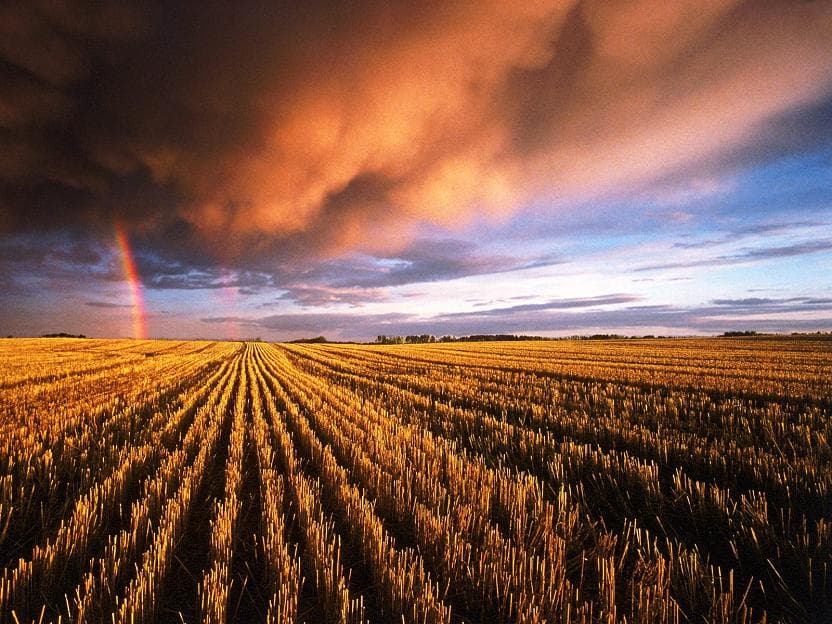
Saskatchewan Farmland Remains in Demand
Saskatchewan farmland is still showing real strength heading into the last quarter of 2026. After a few years of rapid appreciation, the market has become more selective, but good land is still pulling strong offers — especially when it's well located, has solid soil, and fits naturally into an existing operation.
FCC reported that Saskatchewan cultivated farmland values rose 9.4% in 2025, on the heels of 13.1% in 2024 and 15.7% in 2023. We don't have FCC's final 2026 numbers yet, but from what I'm seeing across the province, there's been no broad correction. What's changed is that the market is separating more clearly between premium land and average land — good ground is still finding buyers, they're just a lot more disciplined about what they'll pay for it.
The Numbers at a Glance
- 2025 Saskatchewan farmland growth: +9.4% (2024: +13.1%, 2023: +15.7%)
- Bank of Canada overnight rate: 2.25%
- SK farm cash receipts: up strongly through the first half of 2026
- 2026 harvest: significantly later than normal
- Best demand: productive cultivated land near established operations
- Market direction: firm, but increasingly selective
Three Years of Slowing — But Still Positive — Growth
| Year | SK Farmland Growth |
|---|---|
| 2023 | +15.7% |
| 2024 | +13.1% |
| 2025 | +9.4% |
| 2026 | TBD — FCC data pending |
Each of the last three years has grown more slowly than the one before it. That's a cooling trend, not a correction — land values are still climbing, just not at the breakneck pace of 2022–2023.
Interest Rates Are Helping
One real difference between today's market and a few years ago is the cost of borrowing. The Bank of Canada's overnight rate currently sits at 2.25% — well below where it was during the 2023–2024 tightening cycle. That doesn't suddenly make farmland cheap, but it does improve the math for well-capitalized operators looking to expand.
That matters because Saskatchewan farmland is still expensive relative to the income it generates on its own. For a lot of buyers, the question isn't really whether a quarter cash-flows by itself — it's what that quarter adds to the operation over the next ten, twenty, or thirty years. That longer view is a big part of what's kept land prices supported.
2026 Farm Income Has Been Stronger
There are some encouraging numbers underneath the land market too. Statistics Canada reported that Saskatchewan posted the largest increase in farm cash receipts of any province through the first half of 2026 — up roughly $744.5 million compared to the same period in 2025. Canola did a lot of the heavy lifting here, with higher marketings and stronger prices boosting receipts substantially.
That doesn't mean every farm had a great year. Input costs are still high, yields vary a lot by area, and grain quality has become a concern in parts of the province. But overall, stronger revenue and existing land equity are keeping established operators in a position to keep buying.
The Big Story Right Now: Harvest
The 2026 harvest has been far from normal. As of September 21, only 41% of Saskatchewan's crop had come off, compared to a five-year average of 82%. The southwest was furthest along at 67%, while parts of the north and east were well behind that. Rain, wet fields, and unusually high humidity slowed combines across the province all through September, and in some areas cereals and pulses still standing have started sprouting and losing quality.
Land values aren't set by a single harvest, but farm profitability still affects how aggressively buyers bid. If crop quality keeps slipping in a given area, I'd expect buyers to get more cautious on marginal land. Premium ground tends to be a different story — it holds up regardless.
Good Land Is Separating From Average Land
This is probably the biggest trend I'm seeing in the Saskatchewan market right now. There's less and less value in talking about a single “dollar per acre” number for farmland in general. Two quarters a few miles apart can sell for very different prices depending on soil class, cultivated acres, drainage, stones, topography, access, field shape, historical productivity, location, existing rental arrangements, and who the nearby buyers happen to be.
The strongest land still attracts multiple serious buyers. Lower-quality or awkward parcels can sit a lot longer, especially when a seller's expectations are based on the best sale in the RM rather than truly comparable land.
Location Still Matters — A Lot
Neighbouring farmers remain some of the strongest buyers out there. A quarter next to an operator's existing land can genuinely be worth more to that farmer than the exact same quarter would be to someone thirty miles away. It can cut down equipment movement, improve field efficiency, round out a contiguous block, and open up options for drainage, grain storage, or future expansion.
That strategic value is a big reason premium land can sell at numbers that are hard to justify by rent alone.
Northern & Eastern Saskatchewan Remain Strong
Northern and eastern Saskatchewan continue to draw strong demand for productive cultivated land. Areas with dependable rainfall, good black soils, and a heavy concentration of established grain farms remain highly competitive.
Southern Saskatchewan still offers lower entry prices in many areas, but how much lower depends heavily on soil quality and production history — the southeast in particular is tough to generalize. Good land around Weyburn, Regina, Estevan, and the surrounding farming areas can draw plenty of interest when a quality package comes up. The southwest remains more sensitive to moisture history and production risk, though strong operators are still chasing land that fits their existing operation.
Crop Outlook Is Mixed — But Not Weak
| Crop | 2026 Production | vs. 2025 |
|---|---|---|
| Wheat | 16.9 million tonnes | down 9.7% from 2025 |
| Canola | 12.7 million tonnes | up 1.8% from 2025 |
Statistics Canada's September crop estimates show just how variable 2026 has been. Despite lower projected yields than last year's record crop, Saskatchewan seeded substantially more canola this year, and harvested acreage is projected at a record level. The crop is out there — the bigger concern heading into October is getting it off safely and keeping quality intact.
Farmland Rent Isn't Keeping Up With Land Prices
Another trend worth watching is the gap between farmland prices and cash rent. FCC reports that rent-to-price ratios across Canada have been declining as land values climb faster than rental rates, and that holds true in Saskatchewan too.
From an investor's perspective, farmland bought purely for cash yield is harder to justify at today's prices. Producers see it differently, though — ownership gives them something rent never will: control of the land and the long-term appreciation that comes with it. That difference is a big part of what separates what an investor is willing to pay from what an expanding farmer is willing to pay.
What Is Fair Rent?
There's no single Saskatchewan rental rate. I've seen productive cultivated land support rents around $100 per cultivated acre and up, while lower-quality ground rents for a lot less — and in some cases, premium land can command considerably more than that.
The number that actually matters isn't rent per titled acre, it's what the rent works out to on the acres that actually grow a crop. A quarter with 145 cultivated acres is a different economic proposition than one with 110. Always run the numbers on what's actually producing.
Are Investors Still Buying Saskatchewan Farmland?
Yes, but the economics have shifted. Investors are still drawn to Saskatchewan farmland for a lot of the same reasons they always have — limited supply, long-term appreciation, productive agricultural use, rental income, a hedge against inflation, and land values that remain relatively inexpensive compared with some other major Canadian agricultural regions.
That said, today's buyers need to go in understanding that Saskatchewan farmland isn't a high-yielding passive investment at a lot of current purchase prices anymore. The appeal is increasingly a combination of modest rental yield plus long-term land appreciation, rather than strong cash flow on its own.
What I'm Seeing in the Market
Working directly with farmland buyers and sellers across Saskatchewan, here's how I'd describe the October 2026 market: strong, but no longer indiscriminate. The best properties still create real competition. Average land needs to be priced properly to move. Land with issues needs to reflect those issues in the price. And location can completely change the outcome on two otherwise similar quarters.
I'm also seeing buyers dig a lot deeper into the details behind a listing — cultivated acres, assessment, soil class, rental history, comparable sales — instead of just leaning on an average price per acre. That's a good sign. It means the market is maturing.
Should You Sell Farmland in 2026?
For landowners thinking about selling, this is still a historically strong market. Values have appreciated significantly over the past several years, and there are still well-capitalized farmers out there looking to expand. But every parcel is different, and “what is Saskatchewan farmland worth” isn't really the right question. The better one is: what is my farmland worth in today's market?
Answering that properly means looking at actual comparable sales in your area and adjusting for soil quality, cultivated acres, location, and the property's own characteristics. One sale three municipalities over doesn't tell you what your farm is worth.
What About Buyers?
Buyers need to stay disciplined. Good farmland rarely looks cheap when you're the one writing the cheque, but paying a premium for excellent land can still make more sense than getting a “deal” on poor land. Look closely at price per cultivated acre, soil class, assessment, historical yields, drainage, rental potential, financing cost, nearby land values, and how well the parcel actually fits your operation.
Most importantly, don't justify a purchase using your best crop ever. Run the numbers on realistic long-term yields and expenses, not a lucky year.
Looking Toward 2027
1. How the 2026 harvest finishes
A late harvest and quality downgrades could weigh on farm income in certain areas.
2. Interest rates
Lower borrowing costs have helped offset rising land prices so far — any further moves from the Bank of Canada will matter.
3. Grain prices
Strong commodity prices can quickly increase competition for land. Weak prices do the opposite.
4. Cash rents
Rent hasn't kept pace with land appreciation. Something eventually has to give — either rents rise, land appreciation slows, or investor yields stay compressed.
5. Supply
This might be the biggest factor of all. There's still only so much good Saskatchewan farmland for sale. When an excellent parcel comes up beside a strong operator, provincial averages stop mattering much — two motivated neighbours can set the market on their own.
The Bottom Line
Saskatchewan farmland remains one of the strongest long-term agricultural assets in Canada.
The market isn't moving at the frantic pace we saw during the biggest appreciation years, but there's been no broad collapse in demand. Instead, quality matters more than ever — strong soil, high cultivated acres, good drainage, a good location, and good neighbouring farms. Those properties remain extremely desirable.
The market is shifting from a stretch where almost everything appreciated rapidly into one where the best land increasingly separates itself from the rest. For buyers, that means knowing your numbers. For sellers, it means knowing exactly what you own, and using the right comparable sales before deciding what it's worth.
Curious What Your Farmland Is Worth?
I provide no-obligation farmland valuations throughout Saskatchewan using recent comparable sales, soil class, assessment, cultivated acres, and local market activity.
Sources: Farm Credit Canada — 2025 Farmland Values Report & 2025 Farmland Rental Rate Analysis; Statistics Canada — Farm Cash Receipts, January–June 2026 & Principal Field Crop Estimates, September 2026; Government of Saskatchewan — 2026 Crop Reports; Bank of Canada — September 2026 Interest Rate Decision